← ⚖️ Civics · usually met in Std 7-12
Adopted on 26 November 1949 and in force from 26 January 1950 — the rulebook that sets out what the state may do and what it may not.
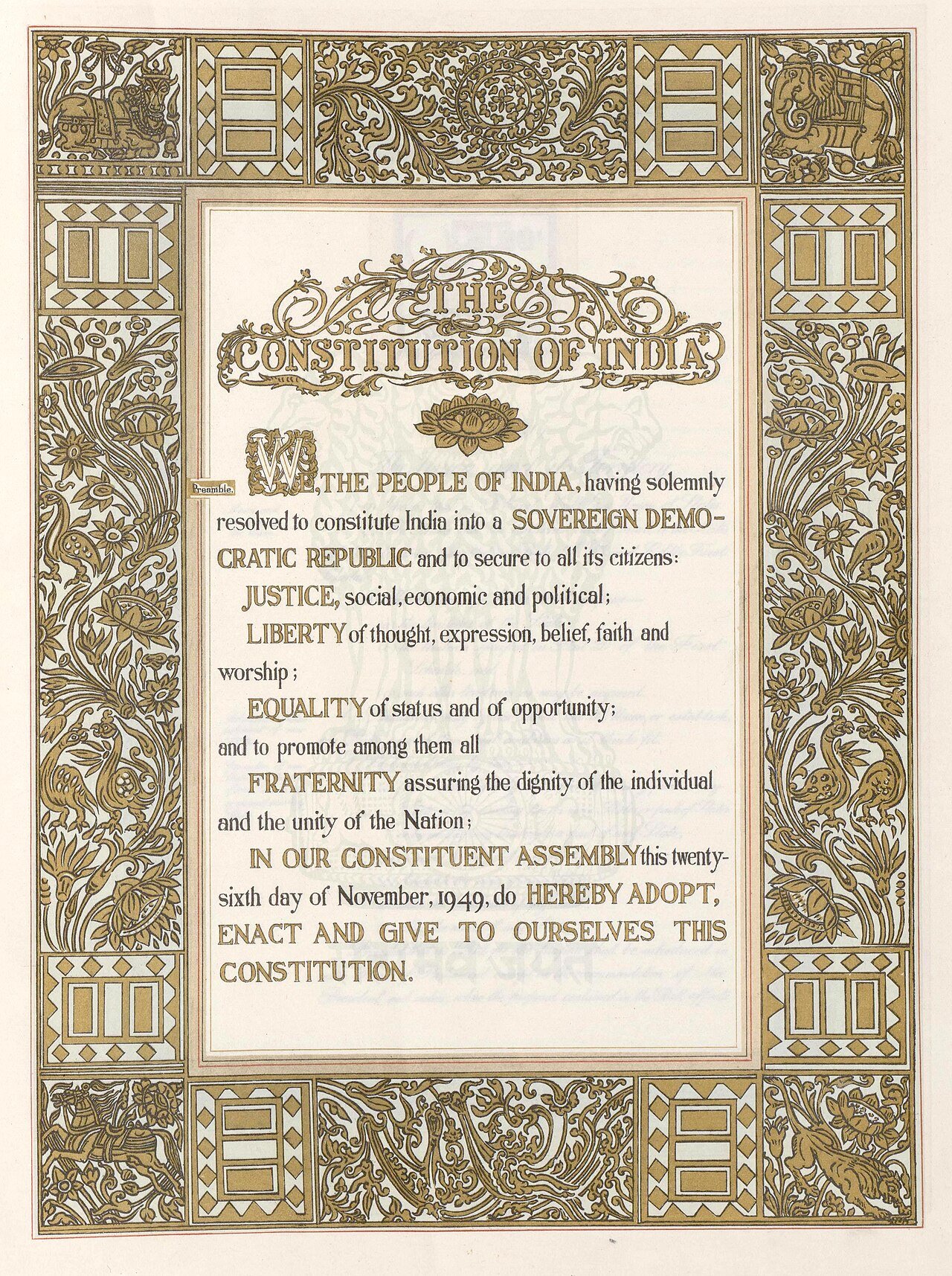
The Constituent Assembly worked for nearly three years. The result establishes India as a sovereign, socialist, secular, democratic republic — the second and third of those words added by amendment in 1976 — with a parliamentary system, a federal structure with a strong centre, and an independent judiciary. It sets out Fundamental Rights, Directive Principles of State Policy, and later Fundamental Duties.
Two features are worth noticing. It is long, because it writes down in detail things other constitutions leave to convention — the drafters did not assume good faith. And it is amendable, but the Supreme Court has held that amendments cannot destroy its basic structure, which is why there is a limit to what any majority can change.
Want to see it moving? Search YouTube for “The Constitution of India” ↗ — we send you to the search rather than to one video, because a link to one video eventually rots.
This entry was written for Star Student in our own words — it is a summary, not a source. Here is where the people who actually hold these facts keep them. Go and check.
Your own textbook ↗Balbharati publishes the textbooks free to read online. Your chapter is the thing to check first — an encyclopedia is a summary, and the syllabus is the syllabus. Election Commission of India ↗How elections are actually run, by the body that runs them.For the Constitution itself, the authoritative text is the one published by the Legislative Department of the Government of India — we have not linked it here because we could not reach it to check the address.
Last gone through: 1 October 2026 · How these entries are written
 Ask GuruAcharya Samayeshwar
