
 Public Speaking and Presentations Demystified
Speaking up in class, giving a speech, managing time, writing neatly and staying focused — the skills no exam tests directly, but every exam and every job rewards.
Start reading ↓ 🧘 Ask Guru
These skills are not talents you are born with. Each one is a routine, practised for a few minutes a day. Pick one this month.
Fluent speakers are not people with less fear. They are people who have spoken more often. Confidence is the result of practice, not the requirement for it.
Hook (a question, a story, a surprising number) → 3 points (never more) → Close (return to the hook, one clear message).
One card per point with 3–4 keywords. Reading a script kills eye contact; keywords keep you speaking, not reciting.
Once silently, twice aloud, once to a mirror, once to a person. Time it — most students speak 30% faster on stage.
Walk up, plant feet, breathe out slowly, look at three faces, smile, start. Nerves peak in the first 10 seconds and then drop.
Hands at waist level, gestures on key words. Eyes move across the room in a slow "W". Pause after important lines.
Never end with "that's it". End with the message, a pause, and "thank you". Then stand still for two seconds.
Preetam Sir's original advice: craft time blocks — study hours, play hours with friends, a television hour, exercise and meditation — and let study hours dominate. Here is the modern version.
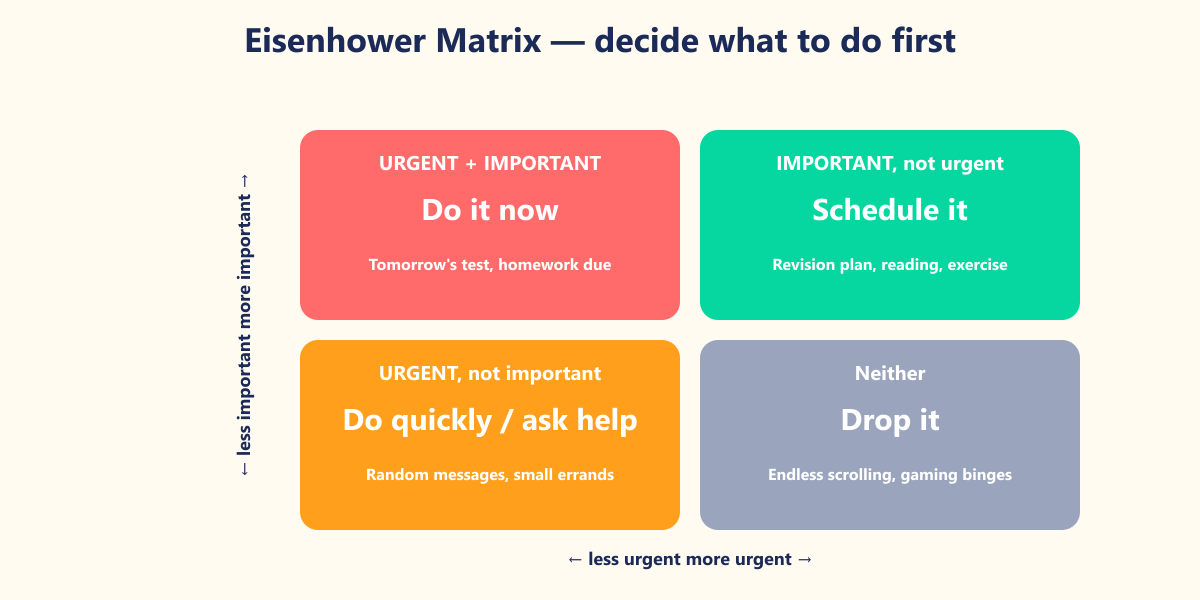
| Time (school day) | Block | Notes |
|---|---|---|
| 6.00 – 6.30 | Wake, water, 15-min walk or stretch | Fixed time even on Sundays |
| 6.30 – 7.15 | Revision block 1 (hardest subject) | Brain freshest; recall, not reading |
| School | Attend fully; one question per class | Homework noted with due dates |
| 4.00 – 5.00 | Play / sport outdoors | Non-negotiable; brain needs it |
| 5.30 – 7.30 | Homework + study (2 × 50 min, 10-min breaks) | Phone in another room |
| 7.30 – 8.30 | Dinner, family, TV hour | Screens off by 9.00 |
| 8.30 – 9.15 | Light revision: mind maps, flash cards | Blank-page recall of the day |
| 9.30 | Sleep | 8+ hours; alarm outside the room |
Studies of board examiners show neat, well-spaced answers score up to 10% higher for the same content. Handwriting is also thinking made visible — slow, clear writing produces slower, clearer thought.
Look at a dot on the wall (or a candle flame) for 2 minutes without looking away. Thoughts come; let them pass. Add 30 seconds each day.
Count 100 to 1 in threes (100, 97, 94…). Lost the place? Start again. Two minutes trains working memory and attention together.
Preetam Sir's technique: draw an imaginary circle around the paragraph you are reading. Nothing outside the circle exists until you finish it.
Study in silence or with wordless music only. Lyrics use the same language circuits as reading.
Books and guides from the Star Student Library for this topic — tap Read to open one here, or Download to keep the PDF.
Public Speaking and Presentations Demystified
 Will Power And Self Discipline
 Grammar for Everyone
 100 Ways to Motivate Others
 How to Write a Business Plan
 Project Management & Leadership Skills for Engineers
 Motivation: Managing the Challenge
A topic you cannot crack, a definition, a full-marks answer, a question about life — Acharya Samayeshwar explains it aloud and in writing, for your board and Std.
 Ask GuruAcharya Samayeshwar