
 Motivation: Managing the Challenge
How to plan, focus, read a textbook, take notes, solve hard chapters and write an exam — explained with the science, then turned into small steps you can try tonight.
Start reading ↓ 🧘 Ask Guru
Most students were never taught how to study — only what to study. Yet fifty years of learning research agree on a handful of methods that beat "reading the chapter again" by a wide margin. This page teaches those methods.
Motivation is not a feeling you wait for. It is a result of starting. The brain rewards the first five minutes of work with a small dose of dopamine — and then wants more.
Ask a topper "how do you feel like studying every day?" and they will tell you the truth: they often don't. They sit down anyway, because the routine decides, not the mood. Once the routine is fixed (same place, same time, same first task), the brain stops arguing.
Promise yourself only five minutes. Open the book, solve one sum. Almost always you continue — because starting was the hard part.
"Finish Chapter 4" is vague. "Solve exercise 4.2, questions 1–8" is a target the brain can tick off. Ticking releases dopamine.
Write, in one line, why this subject matters to you — a career, a person you admire, a thing you want to build. Stick it on the desk.
Reward finishing the plan, not the marks. Marks come later; the plan is under your control today.
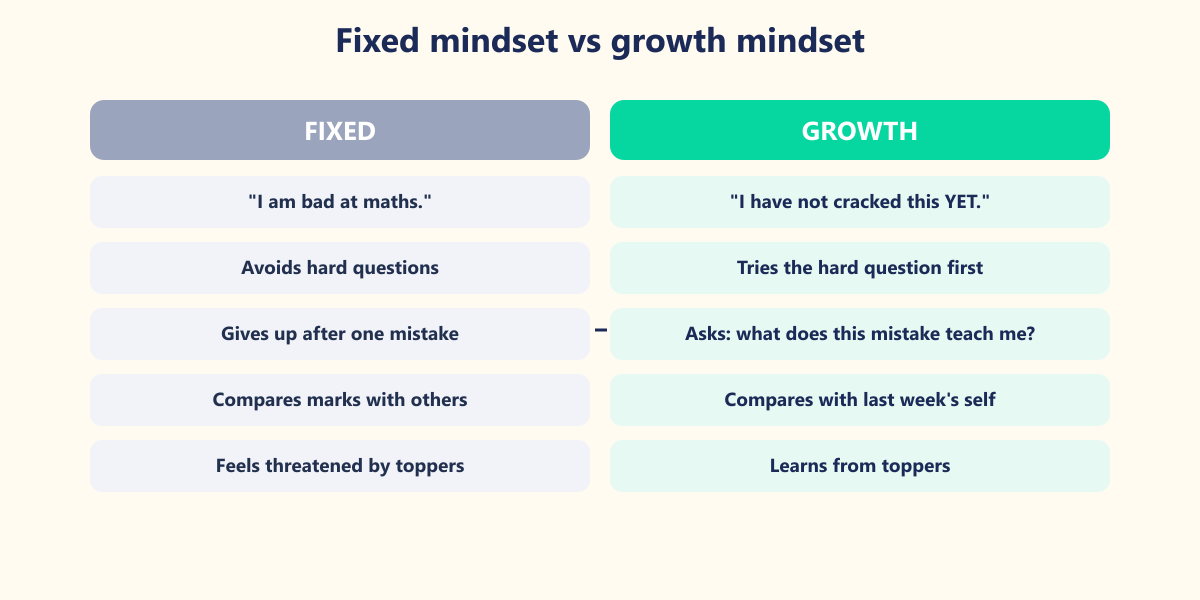
Research following thousands of students found that self-discipline predicted marks twice as strongly as IQ. The good news: discipline is a set of habits, and habits can be built.
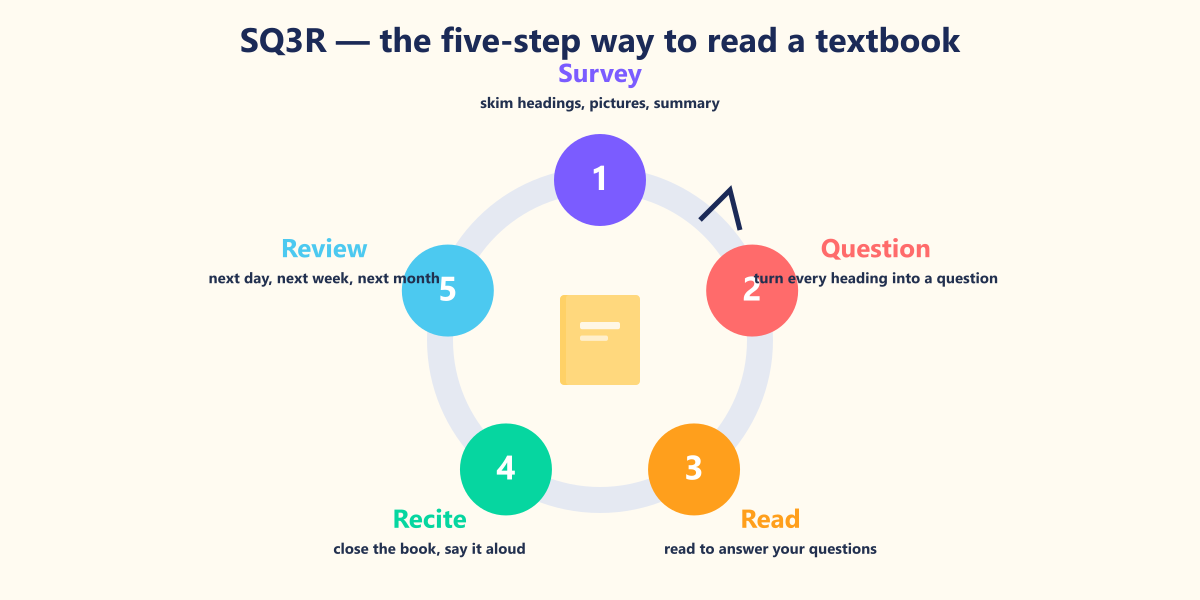
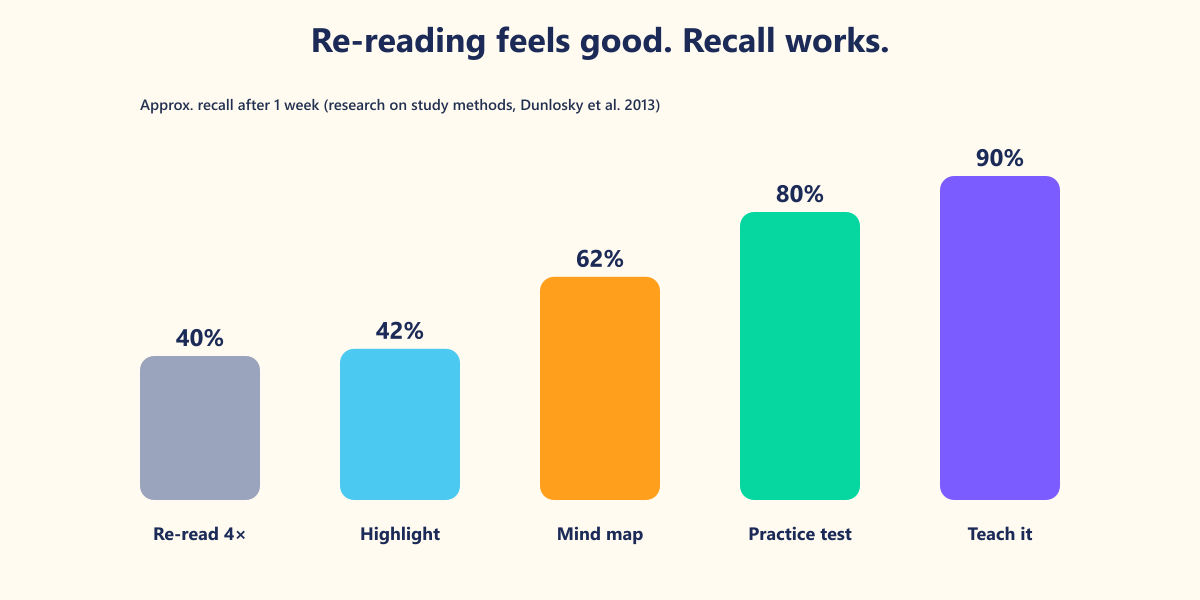
Reading a chapter once from top to bottom is the slowest way to learn it. SQ3R (Survey · Question · Read · Recite · Review) turns reading into a conversation with the book.
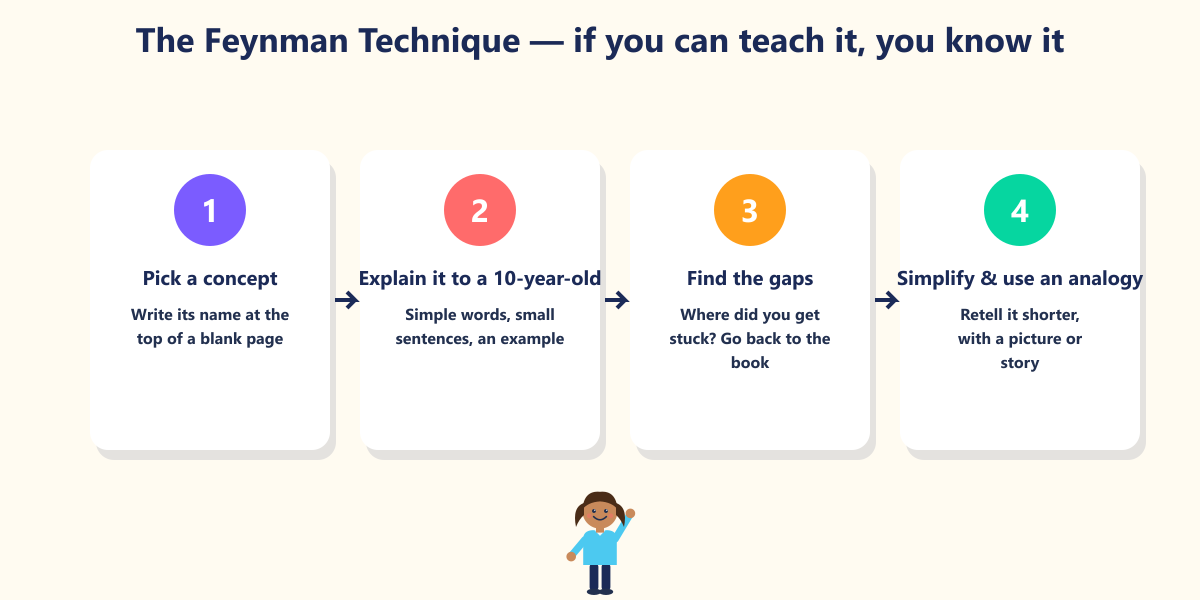
A "tough" chapter is usually a chapter with one missing idea underneath. Find the missing brick and the wall stands up on its own.
Attention is like a muscle: it tires, it recovers with rest, and it grows with training. Nobody focuses for three hours. Toppers focus for 25 minutes — eight times.
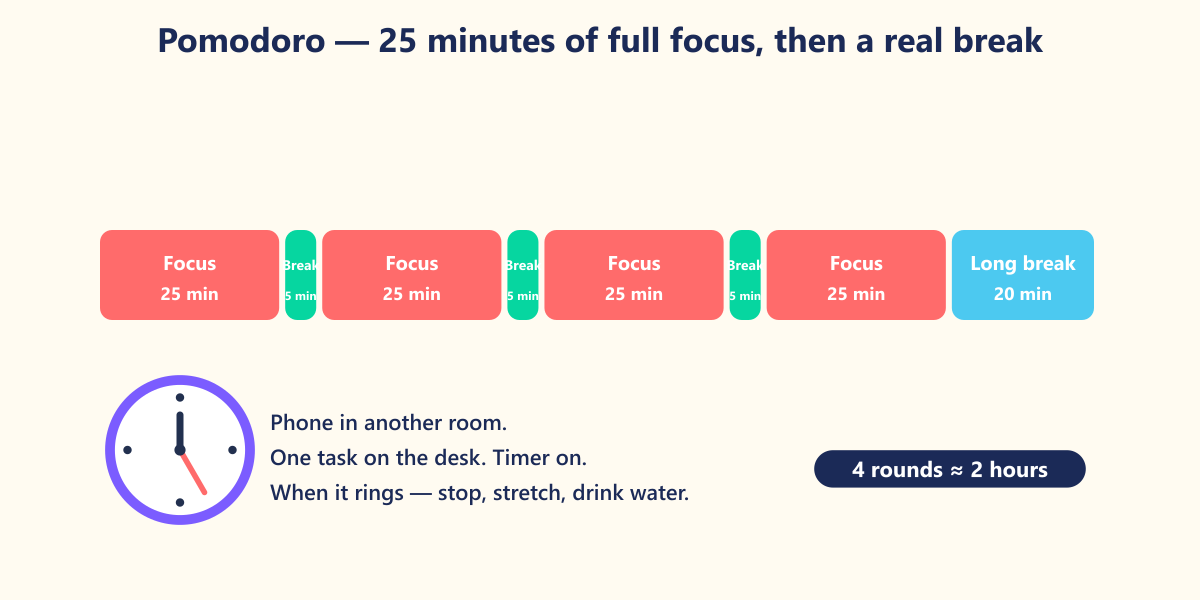
Studies show a phone face-down on the desk still reduces working memory — the brain spends effort ignoring it. Out of sight, out of mind is literally true.
Study at the same desk every day and the brain learns: this chair = focus. Never study on the bed — the bed means sleep.
Even 2% dehydration slows attention. Dim light tires the eyes and brings headaches. Bright desk lamp, bottle of water, window if possible.
A thought pops up ("reply to Aarav")? Write it on a side paper and continue. Handle the list in the break. The brain relaxes once the thought is captured.
Notes are not a copy of the textbook. They are your future self's revision sheet — short, visual, in your own words.
Draw a line 6 cm from the left. Right side: notes in class. Left side (that night): questions and keywords. Bottom: a 2-line summary. To revise, cover the right side and answer the left.
For every chapter, one A4 sheet with the topic in the centre and branches for each heading. Colour per branch. (Full guide on the Mind Maps page.)
Question on one side, answer on the other. Formulas, dates, definitions, reactions. Shuffle; the ones you get wrong go back in the pile.
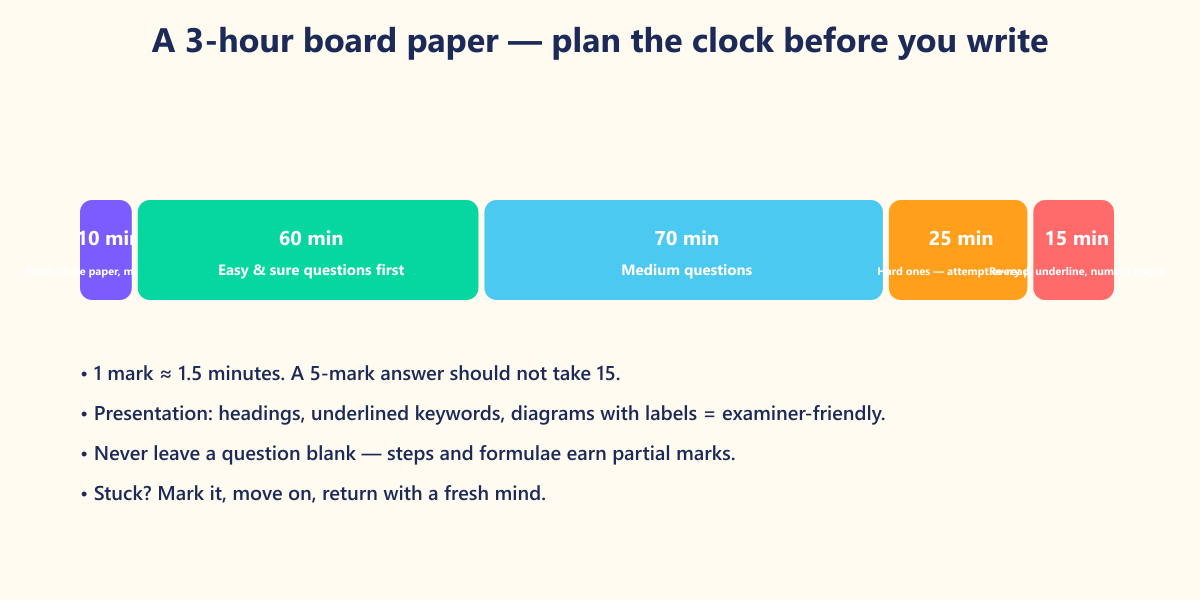
Two students with the same knowledge can score 20 marks apart. The difference is how they manage the clock, the paper and their nerves.
Failure is rarely about intelligence. In our experience across thousands of students, it comes down to six fixable causes.
| Root cause | What it looks like | The fix |
|---|---|---|
| Passive studying | Reads the chapter three times, feels ready, blanks in the exam | Close the book and recall. Practice tests every week. |
| No plan | Studies whatever is on top of the bag; portions left for the last week | A weekly timetable with every chapter named (see Skills You Need → Time management). |
| Gaps from earlier classes | Std IX algebra is hard because Std VII fractions were never fixed | Go back honestly. Two weeks on basics saves the whole year. |
| Sleep debt & screens | Studies till 1 am, forgets by morning, irritable | 8 hours sleep, phone out of the bedroom, study earlier. |
| Fear of asking | Nods in class, never raises a hand, copies homework | One question per class. Teachers respect questions; they worry about silence. |
| Comparison and panic | Compares with toppers, freezes in exams | Compare with last month's self. Breathing drill (Fitness page) before every paper. |
Discipline is not punishment. It is deciding once, so you do not have to decide every day.
The original Star Student Builder carried Preetam Bose's own method — SAG: See, Arrange, Guide — and a subject-by-subject list of "enhancers": the outside-the-textbook habits that make a subject come alive. Here they are, refreshed.
Frame the topic in your mind first. Skim the whole chapter — even the whole textbook — in advance so you know its shape. "Hail the book."
Turn sentences into points in your own notebook. Group sentences by meaning; leave an imaginary gap between them so each is remembered separately.
Read aloud — read to speak, read to listen. Draw an imaginary circle around the paragraph for single focus. Refer to the dictionary, the internet, the teacher until it is clear.
| Subject | Enhancers (outside the textbook) |
|---|---|
| English | Story books, comics, poems, English songs and news; write stories; a mentor for conversation; translate hard lines to your mother tongue first |
| Mathematics | Maths as a game; money-counting and shop bills for juniors; Sudoku; the loci / memory-palace method for formulae; trial-and-error against the book's theory |
| Science / Physics | Know the scientists and their stories; an encyclopedia of physics; symbols and the maths behind them; home experiments |
| Biology | Visit the lab; draw every organism; species as general knowledge; a love of medicine and doctors |
| Chemistry | Draw the sub-atomic structure; "produce the chemical in formula"; chemistry made the human body |
| History & Civics | Freedom-fighter biographies and story books; memorise events as stories; honour the people |
| Geography | Maps on the wall; diagrams; love of the physical world; culture and horticulture |
| Marathi / Hindi / Sanskrit | Think in the language; story books, poems, songs, news and films in it; conversation every day |
| Accounts (XI–XII) | Perfection through introspection — "imperfection leads to less marks"; solve playfully; talk to the teacher about every doubt; see a real company's books |
Books and guides from the Star Student Library for this topic — tap Read to open one here, or Download to keep the PDF.
Motivation: Managing the Challenge
 Critical Analytical Thinking
 Revision & Exams
 In the Exam
 Developing Essential Study Skills
 Study Skills Handbook
 The Buzan Study Skills Handbook
 Questions Decoded
 The Buzan Study Skills Handbook
 The PhotoReading Whole Mind System
 How to Study (7th ed.)
A topic you cannot crack, a definition, a full-marks answer, a question about life — Acharya Samayeshwar explains it aloud and in writing, for your board and Std.
 Ask GuruAcharya Samayeshwar