Star Student Builder logoStar Student Builder
Body + mind fitness

Fitness, stress and a calm mind

Twenty minutes of movement makes the brain learn better for two hours. Here is the science of exercise, the classroom exercises, the stress busters, and simple meditation and yoga for students.

Start reading ↓ 🧘 Ask Guru
Fitness, stress and a calm mind
Exercise and the brainClassroom and desk exercises (2–3 minutes each)Stress busters that actually workMeditation and yoga for studentsBrain fitness: games and puzzlesFrom the library: yoga, calm & wellbeing

Schools that added daily physical education did not see marks fall β€” they saw them rise. Fitness is not a break from studying; it is part of studying.

01Exercise and the brain

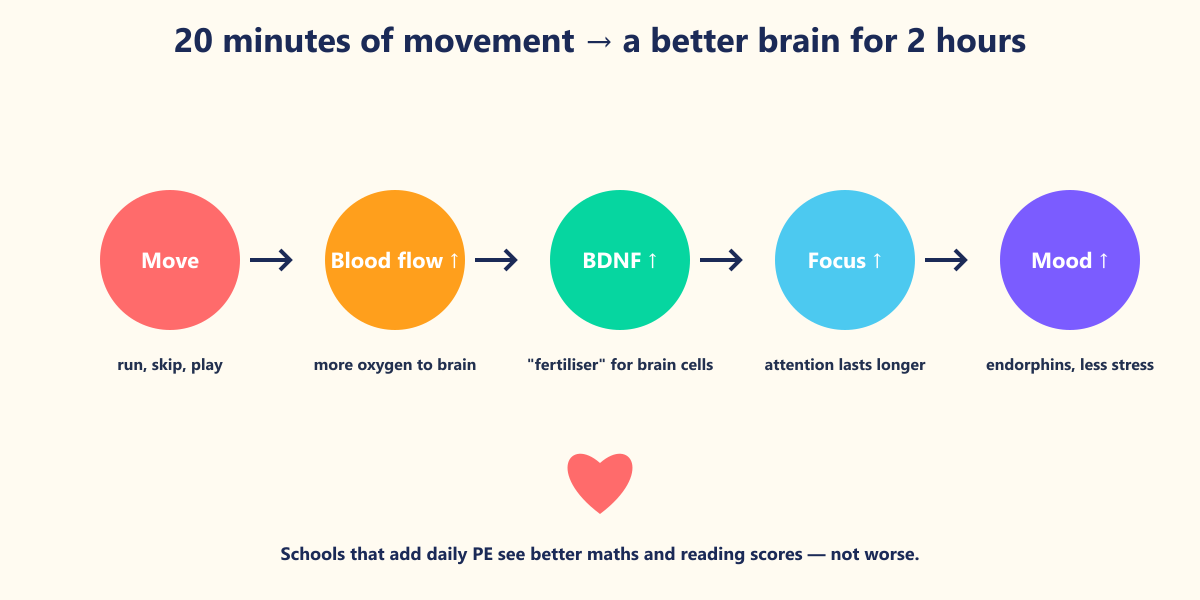
Dr John Ratey (Harvard, author of *Spark*) showed that exercise improves learning on three levels: it sharpens alertness and motivation, it prepares nerve cells to connect, and it grows new brain cells in the hippocampus β€” the memory centre.

The chain from movement to marks. BDNF (brain-derived neurotrophic factor) is the protein Ratey calls "Miracle-Gro for the brain".
Try this todayBefore tonight's study, 10 minutes: 20 jumping jacks, 10 squats, a brisk walk around the building, 10 slow breaths. Then sit. Notice the first 25 minutes of focus.

02Classroom and desk exercises (2–3 minutes each)

No equipment; sneakers help. Warm up with 20 jumping jacks. Teachers: a 3-minute break before a test raises scores.

🌀️

Sky reaches

Stand, reach both arms to the ceiling on tiptoes, hold 15 seconds. 3 times.

πŸ”„

Shoulder blasts

10 forward arm circles, 10 backward, 10 "windshield wipers", 10 "raise the roof".

🦡

Squats

10 slow squats, knees behind toes, back straight. Stand fully between each.

⭐

Star jumps

10 jumps, arms and legs wide in the air, land softly.

πŸ§—

Mountain climbers

Hands on the desk (check it is stable), run knees to chest β€” 20 switches.

🌞

Sun salutation

Reach up, fold down, step back to plank, lower, cobra 5 s, downward dog 5 s, step forward, rise. 5 rounds.

🐸

Frog jumps

Squat low, jump forward, land soft. 12 jumps.

πŸ’ͺ

Desk push-ups

Hands on desk edge, body straight, 12 push-ups. Harder: T push-ups with a 5-second hold.

03Stress busters that actually work

Some stress is useful β€” it is the body getting ready. Too much, for too long, shuts thinking down. The skill is keeping yourself in the middle zone.
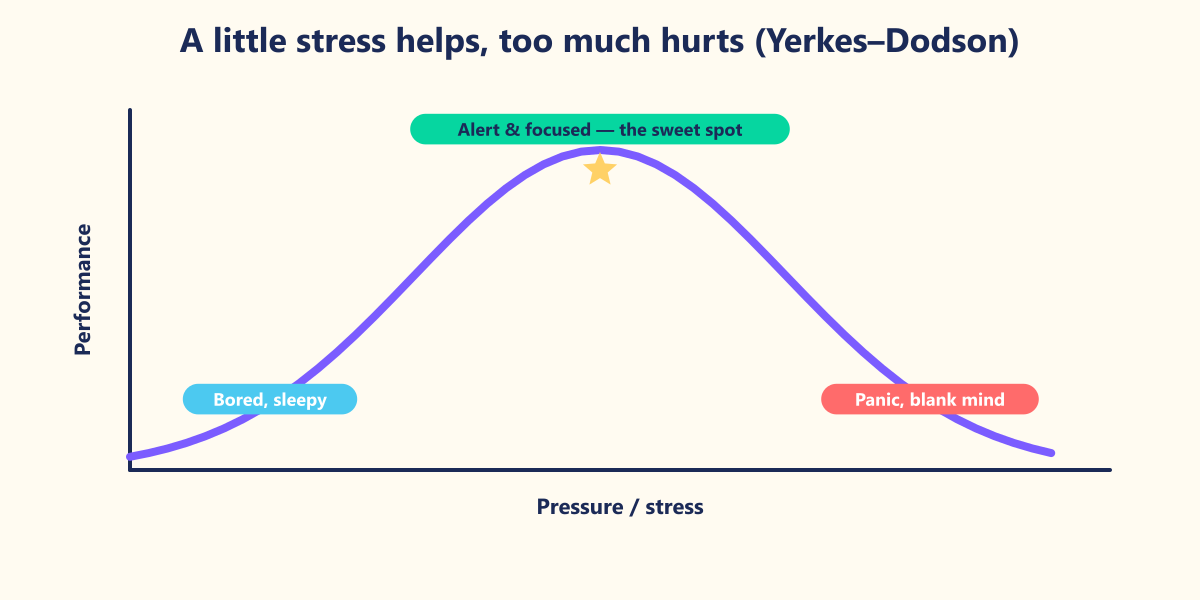
The Yerkes–Dodson curve (1908): performance rises with pressure up to a point, then collapses. Exam panic is the right side of the curve.
"Possibilise", don't "terribilise"Catch catastrophic self-talk ("I must ace this or I am finished") and replace it: "This is one test. Some stress is good. I have prepared." Say "Stop" out loud to the spiral. (Kathryn Tristan, *Why Worry?*)
Four diaphragm breathsHand on belly. In through the nose for 4 counts (belly rises), hold 4, out through the mouth for 6. Four rounds lower heart rate within a minute β€” use it before every paper.
Chunk the mountainA project or a syllabus is stressful as a whole. List the steps with a time for each. Stress drops the moment the first step is small.
MoveWalk, run, dance, skip. Exercise burns the stress hormones (cortisol, adrenaline) that would otherwise stay in the blood.
Progressive muscle relaxationLying down, tense each muscle group for 5 seconds then release β€” feet to face. Ten minutes; excellent before sleep in exam week.
Come to the presentAsk: What do I see? What do I hear? What do I feel on my skin? Five senses, one minute. Worry lives in the future; the senses live now.
Lower the goal, achieve moreAim to feel satisfied with honest work, not to top the class. Students who set "good-enough" goals outperform those chasing perfection β€” and enjoy the year.
For parentsThe AP-MTV survey found school is the number-one stressor for 13–17-year-olds. The most protective factors: sleep, a parent who listens without lecturing, and play time that homework does not eat. If a child says "I can't cope", that is information, not drama.

04Meditation and yoga for students

πŸ•‰οΈ

Om / breath meditation (5 min)

Sit straight, eyes closed. Breathe in slowly; on the out-breath say a long "Om" or simply count "one". Thoughts come β€” return to the breath. Five minutes, twice a day.

🧘

Body scan (10 min)

Lie down. Move attention slowly from toes to head, noticing each part. Perfect after a study block or before sleep.

πŸŒ…

Morning yoga (12 min)

Surya Namaskar 5 rounds, Vrikshasana (tree) 30 s each side, Bhujangasana (cobra), Balasana (child), Shavasana 2 min.

πŸ“±

Guided apps

Calm, Headspace (free basics), Insight Timer (free), or the 5-minute kids' meditations on YouTube linked below.

Advanced: what meditation does to the brainEight weeks of 10-minute daily mindfulness practice thickens grey matter in the prefrontal cortex (attention, decisions) and shrinks reactivity of the amygdala (fear, stress). School programmes measuring this report better attention scores, fewer discipline problems and lower anxiety. It is the cheapest brain upgrade there is.

05Brain fitness: games and puzzles

Preetam Sir's prescription for a "wired" brain: brain games, a new language, speed reading, story-telling with parents, outdoor play instead of touch-screens, and puzzles solved as a family.

06From the library: yoga, calm & wellbeing

Books and guides from the Star Student Library for this topic β€” tap Read to open one here, or Download to keep the PDF.

See the whole Wellness & yoga shelf β†’

Have a doubt? Ask Guru 🧘

A topic you cannot crack, a definition, a full-marks answer, a question about life β€” Acharya Samayeshwar explains it aloud and in writing, for your board and Std.

Ask Guru β†’
Ask GuruAcharya Samayeshwar