← 🪐 Space · usually met in Std 5-10
One ordinary star, eight planets, several dwarf planets and a very great deal of smaller debris, all held in orbit by the Sun's gravity.
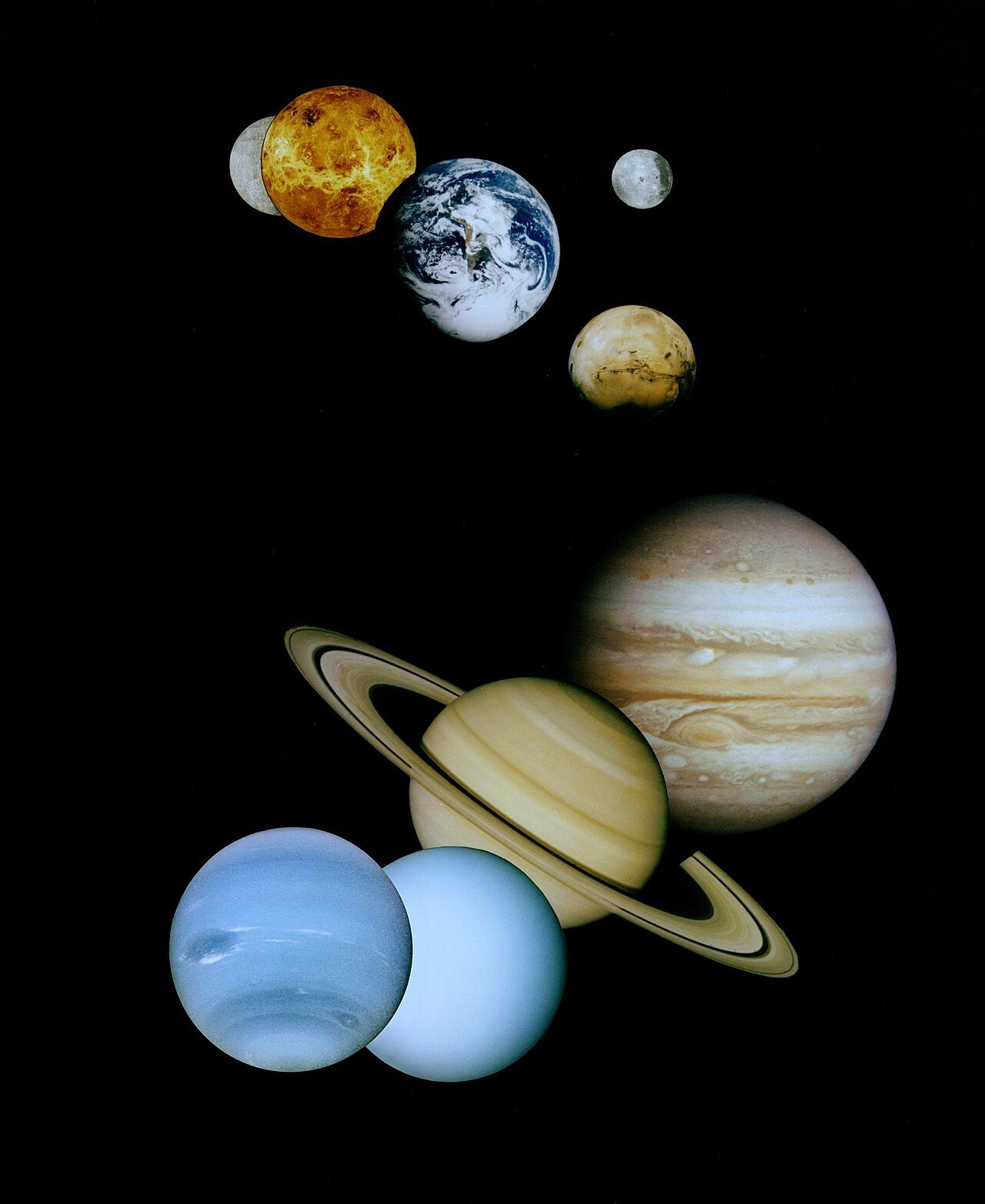
The four inner planets — Mercury, Venus, Earth, Mars — are small, rocky and close together. Beyond the asteroid belt the four outer ones — Jupiter, Saturn, Uranus, Neptune — are enormous and made mostly of gas and ice. Pluto was reclassified as a dwarf planet in 2006, not because anything about it changed, but because enough similar objects were found that the word planet had to be defined properly.
Distances are the part that never fits on a classroom poster. If the Sun were a football, the Earth would be a peppercorn about 26 metres away, and Neptune would be most of a kilometre off. Light from the Sun reaches us in eight minutes and takes over four hours to reach Neptune.
Want to see it moving? Search YouTube for “The solar system” ↗ — we send you to the search rather than to one video, because a link to one video eventually rots.
This entry was written for Star Student in our own words — it is a summary, not a source. Here is where the people who actually hold these facts keep them. Go and check.
Your own textbook ↗Balbharati publishes the textbooks free to read online. Your chapter is the thing to check first — an encyclopedia is a summary, and the syllabus is the syllabus. ISRO ↗India's space agency — missions, instruments and results, first hand. NASA — the solar system ↗Planetary data and images from the people flying the spacecraft.Last gone through: 1 October 2026 · How these entries are written
 Ask GuruAcharya Samayeshwar
