Water That Walks
✨ Coloured water climbs up a paper strip all by itself and pours into an empty glass next door.
🧰 You need
- three glasses
- water
- two food colours or beetroot and turmeric juice
- strips of kitchen paper or tissue
- a spoon
👀 What you will see
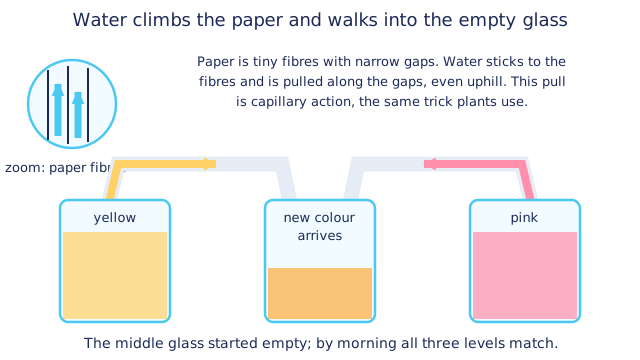
A dark wet line creeps up the paper, going uphill even though nothing is pushing it. The two colours travel along the bridges and drip into the middle glass. By morning the middle glass holds a new mixed colour and all three levels are nearly equal.
🧪 Do it
- Fill the two outside glasses with water and stir a different colour into each.
- Leave the middle glass completely empty.
- Fold two paper strips lengthways and bridge each coloured glass to the middle one.
- Make sure each end of a strip is dipping into a glass.
- Look after ten minutes, after an hour, and again the next morning.
💡 Why it happens
Kitchen paper is made of tiny fibres with narrow gaps between them. Water sticks to the fibres and gets pulled along those gaps, even upwards, and this pull is called capillary action. Water also holds on to itself, so a whole thread of water follows the first drops along the strip. Plants move water from their roots to their leaves using narrow tubes in a very similar way.
🔁 Now try this
Build one bridge from kitchen paper and one from a strip of plastic sheet, and see which one the water will climb.
🤔 Think about it
Would a wide strip carry the water faster than a thin one?
🧘 Ask the Acharya
“Would a wide strip carry the water faster than a thin one?” — ask him and he will explain it from your own chapters.
More for Std 1–2
Sink or Float Tray
A big plastic lid rests on the water while a tiny coin drops straight to the bottom.
Try it →Science15 minDancing Raisins
The raisins rise to the top, wobble and sink again, over and over, as if they had learned to dance.
Try it →Science10 minBalloon Hair Magic
A rubbed balloon makes your hair stand up and then bends a falling stream of water without ever touching it.
Try it →